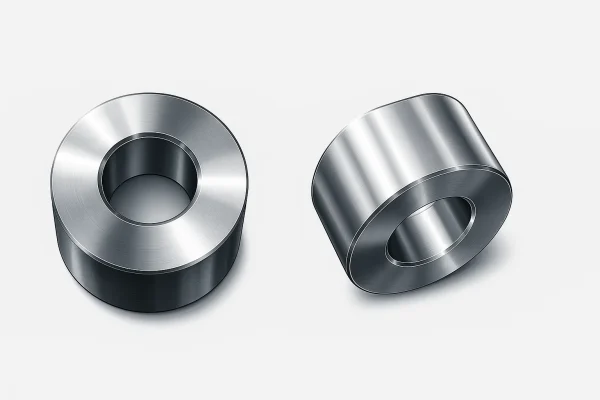
What is a Distance Bush?
In aerospace applications, a Distance Bush is a critical mechanical component designed to maintain precise spacing and alignment between structural or moving parts in assemblies. Typically cylindrical and hollow, it functions as a spacer or support element, ensuring that components are positioned correctly relative to each other while reducing wear and minimizing vibration.
Key Features of Distance Bush
Precision Machining
Manufactured to exact dimensional tolerances to maintain accurate spacing essential for aerospace assemblies.
High Strength-to-Weight Ratio
Made from lightweight yet strong materials such as aluminum alloys or titanium, balancing durability and weight constraints critical to aerospace performance.
Corrosion Resistance
Often treated with protective coatings or made from inherently corrosion-resistant materials to endure harsh environmental conditions.
Wear Resistance
Designed to reduce friction and wear between adjoining components, extending service life and reliability.
Versatility
Available in various sizes and configurations to accommodate different aerospace assembly requirements.
Maintaining Component Spacing: Ensures precise gaps between parts, critical for mechanical alignment and functionality.
Load Distribution: Spreads mechanical loads evenly across connected components, reducing stress concentrations.
Vibration Dampening: Minimizes transmission of vibrations that could damage delicate aerospace systems.
Wear Reduction: Acts as a sacrificial element that bears frictional forces, protecting more critical parts.
Alignment Support: Maintains the correct orientation of shafts, panels, or structural members during operation.
Enabling Assembly Flexibility: Simplifies the integration of components with varying sizes and tolerances.
Enhancing Operational Safety: By ensuring components stay in place and operate smoothly, it contributes to the overall safety of aerospace systems.