
Connecting Tracks and Fields: How Smart Automation Is Transforming Railway and Agriculture
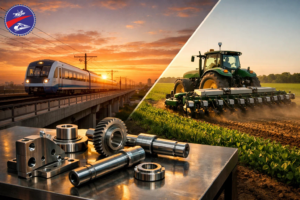
Across India, two sectors are quietly embracing the same transformation. Railway networks and farming operations are both turning to smart automation solutions for railway and agriculture to improve safety, productivity and reliability. Behind this shift is a new generation of component manufacturers who understand that hardware has to match the intelligence of the systems it supports.
Vaani Precision Industries works at that intersection. The company produces critical machined parts and sub‑assemblies that go into braking systems, bogies, couplers, actuators and control mechanisms used on trains, as well as precision parts for automated agriculture equipment. Though the environments differ—dusty tracks versus green fields—the engineering challenge is similar: components must perform flawlessly, every single cycle.
Railways: safer, smarter and easier to maintain
Indian Railways and metro projects are adding sensors, actuators and monitoring systems to improve both safety and uptime. When a train brakes smoothly, couples reliably or adjusts its suspension to track conditions, a chain of mechanical elements is working behind the scenes. Precision components for rail bear loads, transmit motion and hold tight tolerances so that electronics and software can do their job.
Vaani Precision Industries manufactures a wide range of these elements. Brake rigging levers, pins, bushes, brackets, clevises, coupler parts and machined plates are produced using CNC turning centres, machining centres and grinding machines. Each component is designed to withstand vibration, shock and harsh outdoor exposure.
As signalling and control systems become more intelligent, mechanical reliability becomes even more important. Automation devices can only react correctly if the mechanical hardware behaves predictably. That is why materials, heat treatment and surface finishing are controlled so carefully. The company’s shop‑floor processes, from raw‑material inspection to final gauging, are built around long‑term performance.

Agriculture: from manual effort to precision operations
Farming is facing intense pressure to produce more with fewer resources. Labour availability, water constraints and rising input costs all push farmers to adopt smarter technologies. Automated agriculture equipment, such as seeders, planters, sprayers and harvesting attachments, relies on robust linkages and motion‑control parts.
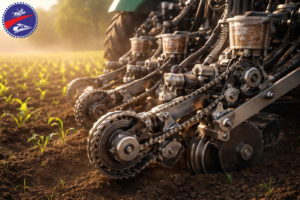
Vaani Precision Industries supplies many of these parts to OEMs and system integrators. Shafts, gears, sprockets, hubs, flanges and adjustment mechanisms are all machined to tight tolerances. When a precision seeder places seeds at consistent depth, or a power harrow maintains uniform soil preparation, it is the mechanical consistency of these components that protects the farmer’s investment.
The same CNC machined components that support high‑speed rail applications also find homes in rugged agricultural machines. Materials and coatings are selected to handle dust, mud, fertilisers and outdoor storage. By combining engineering know‑how with an understanding of field conditions, the company helps equipment makers deliver tools that last through many seasons.
Automation as a unifying theme
Industrial automation in India is no longer limited to big factories. Compact actuators, feedback devices and control modules are now embedded in railway yards, depots and farm equipment. For each of these, the mechanical interface is critical.
-
In a yard, powered switch machines move heavy railway points. Their internal cams, shafts and gear sets must operate smoothly despite varying loads.
-
On a tractor, a hydraulic control valve uses precision pins and spools to modulate flow to attachments. Small dimensional errors can cause leakage or jerky operation.
The role of a precision manufacturer is to convert digital drawings into physical parts that meet these tight demands. Vaani Precision Industries uses process plans that define every step—tool paths, cutting parameters, inspection points and packaging. This standardisation reduces variation between batches and ensures that automation systems can be replicated at scale.
Design collaboration with OEMs
For both railway and farm equipment builders, time‑to‑market is a constant concern. When new platforms or variants are introduced, designers need suppliers who can turn concepts into manufacturable parts quickly.
The engineering team at Vaani Precision Industries works closely with customers to review drawings for manufacturability. Suggestions may include adding radii to reduce stress concentrations, simplifying profiles for better tool access, or adjusting tolerances where appropriate. This collaboration helps reduce development loops and lowers overall cost without compromising function.
Once designs are frozen, dedicated fixtures and inspection gauges are developed. This approach is especially important for assemblies like brake kits, coupler interfaces or agricultural linkages, where multiple parts must fit together in the field without rework.
Reliability built on process discipline
Rail vehicles and agricultural machines are expected to operate for years with minimal downtime. Component manufacturers must therefore maintain consistent quality over thousands of parts and many production runs.
Vaani Precision Industries follows documented procedures for incoming inspection, in‑process checks and final verification. Tool wear is monitored, and corrective actions are taken before dimensions drift out of tolerance. For critical items, 100% inspection is carried out on key features.
Traceability is another pillar of reliability. Heat numbers, batch records and inspection reports are stored so that any issue in the field can be traced back to a specific lot. This discipline gives OEMs confidence that their own obligations to rail authorities and farmers will be met.
Sustainability and efficiency
Both railway operations and agriculture are under pressure to reduce their carbon footprint. Efficient braking reduces energy loss, and reliable couplers reduce the need for heavy emergency interventions. On farms, precise seeding and fertiliser placement reduce wasted inputs and environmental impact.
By supplying accurate and durable components, Vaani Precision Industries enables equipment that runs more efficiently over its life cycle. Fewer breakdowns mean fewer replacement parts, less scrap and lower fuel consumption. In this sense, precision machining contributes directly to more sustainable transport and food systems.
Looking ahead
The convergence of automation and connectivity will continue to change how trains move and how crops are grown. As these systems become smarter, they will demand even tighter integration between mechanical, electrical and digital elements.
Vaani Precision Industries plans to remain a reliable partner in this journey. Investment in advanced machines, improved fixturing and better measurement tools will expand capability for complex components and assemblies. At the same time, the company will continue to place equal emphasis on communication, documentation and on‑time delivery, because these are what turn hardware into trust.
For railway operators, agricultural equipment manufacturers and automation integrators, working with such a partner means the assurance that every shaft, bracket and linkage has been produced with care. For the wider economy, it means that two foundational sectors—transport and farming—are better prepared for the future.