
Introduction
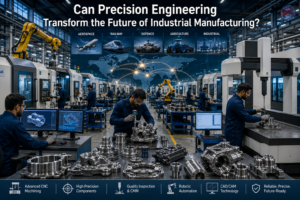
Modern industries are evolving at an unprecedented pace. Whether it’s aerospace, defence, railways, agriculture, or automotive manufacturing, today’s products demand exceptional quality, reliability, and performance.
This evolution raises an important question:
Can precision engineering truly transform the future of industrial manufacturing?
The answer lies in the increasing need for highly accurate, durable, and repeatable components that meet strict engineering standards. As industries adopt smarter technologies and more sophisticated machinery, Precision Engineering has become the foundation of modern manufacturing.
Companies like Vaani Precision Industries are helping shape this transformation by delivering precision-machined and fabricated components that support critical industries across India and international markets.
What is Precision Engineering?
Precision engineering is the process of designing and manufacturing components with extremely tight tolerances using advanced machinery, modern manufacturing techniques, and rigorous quality control.
Unlike conventional machining, precision engineering focuses on producing components that fit perfectly, perform consistently, and maintain their dimensional accuracy throughout their operational life.
Typical precision-engineered components include:
- Precision bushes
- Shafts
- Sleeves
- Housings
- Couplings
- Brackets
- Custom machined components
- Fabricated assemblies
These components are essential across industries where reliability and performance are critical.
Why Precision Engineering Is Becoming More Important
Modern industrial equipment has become increasingly complex.
Machines today operate at:
- Higher speeds
- Greater loads
- Increased temperatures
- Longer operational cycles
Even a minor variation in component dimensions can lead to:
- Increased wear
- Assembly issues
- Higher maintenance costs
- Reduced operational efficiency
- Equipment failure
This is why manufacturers increasingly rely on Precision Engineering to ensure every component meets exact specifications.
The Role of CNC Machining in Precision Manufacturing
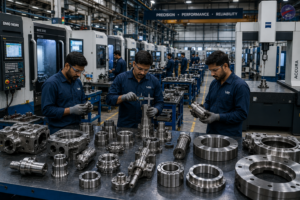
One of the biggest contributors to precision engineering is CNC Machining Services.
Modern CNC machines allow manufacturers to produce highly accurate components repeatedly with minimal variation.
Benefits include:
Exceptional Accuracy
Computer-controlled machining minimizes dimensional errors.
Complex Component Production
Advanced CNC systems manufacture intricate geometries that would be difficult using conventional machining.
Consistent Quality
Every production batch maintains identical specifications.
Faster Production
Automation improves efficiency while reducing manufacturing lead times.
Better Surface Finish
Precision machining creates smooth surfaces that enhance product performance and durability.
These advantages have made CNC machining indispensable for modern manufacturing.
Precision Engineering Across Multiple Industries
One of the greatest strengths of precision engineering is its versatility.
Aerospace
Aircraft systems require lightweight, durable, and precisely manufactured components capable of operating under demanding conditions.
Defence
Mission-critical applications depend on precision-engineered components that deliver reliability, consistency, and long operational life.
Railways
Brake systems, suspension assemblies, couplings, and structural components require precise manufacturing to ensure passenger safety and efficient freight transportation.
Agriculture
Modern farming equipment depends on durable machined parts capable of withstanding harsh environments and continuous operation.
Automotive
High-performance vehicles rely on precision-engineered mechanical components for efficiency, safety, and long-term reliability.
Why Global Manufacturers Are Looking Toward India
International manufacturers are increasingly partnering with Indian precision engineering companies because of several competitive advantages.
Skilled Engineering Talent
India has one of the world’s largest pools of manufacturing engineers and technical professionals.
Advanced Manufacturing Infrastructure
Modern CNC machining centres and fabrication facilities enable high-quality component production.
Cost-Effective Production
Indian manufacturers provide exceptional value while maintaining international quality standards.
Flexible Manufacturing
Manufacturers can efficiently handle prototypes, custom projects, and large-scale production.
Growing Export Capabilities
India’s engineering sector continues expanding into global supply chains across multiple industries.
Quality: The Heart of Precision Engineering
Producing accurate components is only part of the manufacturing process.
Reliable manufacturers also focus on:
- Material traceability
- Drawing compliance
- Dimensional inspection
- Process consistency
- Final quality verification
Every stage contributes to delivering components that meet customer expectations.
Quality assurance builds confidence, reduces failures, and strengthens long-term business relationships.
How Vaani Precision Industries Supports Modern Manufacturing
As a trusted Precision Engineering Company, Vaani Precision Industries provides manufacturing solutions for customers across multiple industrial sectors.
Its capabilities include:
- CNC Turning
- CNC Milling
- Precision Machining
- Fabrication & Welding
- Custom Engineering Components
- Prototype Development
- Batch Production
- Quality Inspection
- Drawing-Based Manufacturing
With a commitment to engineering excellence, Vaani Precision Industries supports OEMs and industrial manufacturers with precision-engineered components designed for demanding applications.
Emerging Trends in Precision Engineering
The future of manufacturing will be driven by innovation.
Some of the key trends shaping precision engineering include:
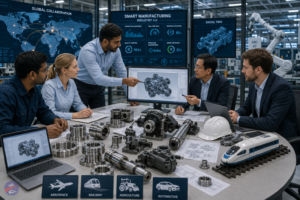
Industry 4.0 Integration
Connected machines and digital manufacturing improve productivity and process control.
Automation
Robotics and automated machining increase consistency while reducing production time.
Smart Inspection Systems
Advanced metrology ensures every component meets exact specifications.
Sustainable Manufacturing
Modern machining technologies reduce waste and improve resource efficiency.
Global Supply Chain Collaboration
Manufacturers increasingly partner across borders to improve resilience and production flexibility.
These developments are redefining how engineering companies compete in international markets.
Conclusion
So, can precision engineering transform the future of industrial manufacturing?
The evidence suggests that it already is.
As industries continue demanding higher quality, greater efficiency, and improved reliability, precision engineering has become a critical enabler of innovation and growth.
From aerospace and defence to railways, agriculture, and automotive manufacturing, precision-engineered components help industries operate more safely, efficiently, and competitively.
Companies like Vaani Precision Industries are contributing to this transformation by combining advanced CNC machining, fabrication expertise, and quality-driven manufacturing processes that support customers across India and global markets.
The future of manufacturing will not simply depend on producing more components—it will depend on producing better, smarter, and more precise components.