
Introduction
Sustainability has become one of the biggest priorities for manufacturers worldwide. Rising material costs, stricter environmental regulations, and growing customer expectations are encouraging businesses to rethink how products are designed, manufactured, and delivered.
While renewable energy and recycling often dominate sustainability discussions, Precision Engineering plays an equally important role in reducing waste, improving efficiency, and extending the life of industrial products.
This raises an important question:
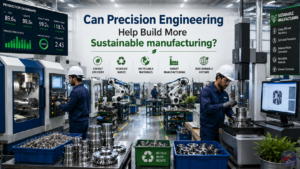
Can precision engineering help build more sustainable manufacturing?
The answer is yes.
By combining advanced CNC Machining Services, optimized production processes, and strict quality control, manufacturers can significantly reduce waste, improve productivity, and produce components that last longer. Companies like Vaani Precision Industries contribute to this transformation by delivering precision-engineered components for industries such as aerospace, defence, railways, agriculture, automotive, and industrial manufacturing.
Why Sustainability Matters in Manufacturing
Manufacturing accounts for a significant portion of global energy consumption and raw material usage. Businesses today must balance productivity with environmental responsibility.
Sustainable manufacturing focuses on:
- Reducing material waste
- Improving energy efficiency
- Increasing product lifespan
- Optimizing production processes
- Supporting responsible resource utilization
These goals not only benefit the environment but also reduce operational costs and improve long-term competitiveness.
The Role of Precision Engineering
Precision engineering is about manufacturing components with exceptional accuracy, consistency, and repeatability.
Every precisely machined component helps minimize errors that could otherwise lead to:
- Product failures
- Excess material usage
- Rework
- Increased maintenance
- Shorter equipment life
High-quality Precision Components ensure machinery operates efficiently while reducing unnecessary replacements and downtime.
How CNC Machining Supports Sustainable Manufacturing
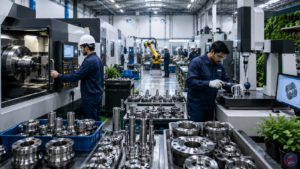
Modern CNC Machining Services have transformed industrial manufacturing by enabling greater control over every stage of production.
Key sustainability benefits include:
Reduced Material Waste
Accurate machining removes only the required amount of material, helping manufacturers maximize raw material utilization.
Higher First-Time Quality
Precision manufacturing reduces defective parts and minimizes rework.
Longer Component Life
Well-machined components experience less wear and maintain performance over extended operating periods.
Optimized Production
Automation and digital programming improve efficiency while reducing production variability.
These advantages contribute to both environmental sustainability and lower manufacturing costs.
Better Components Mean Better Products
A sustainable product begins with reliable components.
Precision-engineered parts contribute to:
- Improved machine efficiency
- Lower maintenance requirements
- Reduced downtime
- Better operational reliability
- Increased service life
Whether used in aerospace systems, railway equipment, agricultural machinery, or industrial automation, quality components directly influence overall product sustainability.
Sustainability Across Multiple Industries
Aerospace
Aircraft manufacturers require lightweight, high-strength components that maximize fuel efficiency while maintaining safety and reliability.
Railway
Precision-manufactured railway components improve operational efficiency and reduce maintenance requirements throughout the lifecycle of rolling stock.
Agriculture
Agricultural machinery operates in demanding environments where durable precision components improve equipment longevity and reduce repair frequency.
Automotive
Modern vehicles depend on precision manufacturing for improved fuel efficiency, performance, and long-term reliability.
Industrial Machinery
Manufacturing equipment built with precision components operates more efficiently, reducing downtime and improving production consistency.
Technology Driving Sustainable Manufacturing
Advanced manufacturing technologies continue to improve sustainability.
These include:
- Multi-axis CNC machining
- CAD/CAM programming
- Digital inspection systems
- Coordinate Measuring Machines (CMM)
- Automated production monitoring
- Smart manufacturing solutions
These technologies help manufacturers produce complex components while minimizing resource consumption.
Why Quality Control Supports Sustainability
Sustainability isn’t only about production—it also depends on consistent quality.
Comprehensive inspection ensures:
- Dimensional accuracy
- Material verification
- Surface finish consistency
- Reliable product performance
- Reduced production waste
Quality-focused manufacturing prevents costly failures while supporting long-term operational efficiency.
Why Businesses Choose Experienced Manufacturing Partners
Selecting the right manufacturing partner has a direct impact on sustainability goals.
Experienced manufacturers provide:
- Engineering expertise
- Advanced machining capabilities
- Consistent production quality
- Reliable delivery
- Continuous process improvement
Long-term partnerships help businesses improve efficiency while maintaining high manufacturing standards.
How Vaani Precision Industries Supports Sustainable Manufacturing
Vaani Precision Industries manufactures precision-engineered components using modern machining technologies and structured quality processes.
Its capabilities include:
- Precision CNC machining
- Custom machined components
- Fabrication and assemblies
- Drawing-based manufacturing
- Quality inspection and validation
- Manufacturing support across multiple industries
By emphasizing accuracy, repeatability, and continuous improvement, the company helps customers achieve better manufacturing outcomes while supporting sustainable industrial growth.
The Future of Sustainable Manufacturing
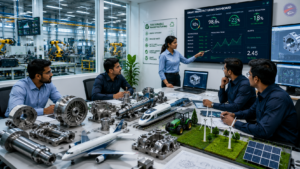
As industries adopt smarter technologies and greener practices, precision engineering will become even more important.
Future manufacturing trends include:
- Digital manufacturing
- AI-assisted production
- Smart factories
- Energy-efficient machining
- Sustainable supply chains
- Advanced automation
- Predictive maintenance
Businesses that invest in precision manufacturing today will be better prepared for tomorrow’s industrial challenges.
Conclusion
Sustainability in manufacturing is no longer optional—it has become a business necessity.
Precision Engineering provides the foundation for producing reliable, efficient, and long-lasting components while reducing waste and improving productivity.
By combining advanced CNC Machining Services, rigorous quality control, and continuous innovation, manufacturers can build products that perform better while supporting a more sustainable future.
As industries continue to evolve, companies like Vaani Precision Industries are helping shape that future by delivering high-quality precision components that support efficiency, reliability, and responsible manufacturing.