
The Backbone of India’s Engineering Future: How Precision Manufacturing is Powering Defence & Aerospace Growth
Introduction
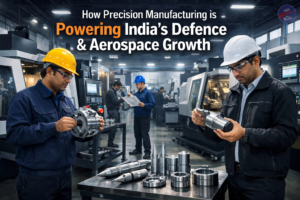
India’s defence and aeronautics landscape is undergoing a major transformation. With the government pushing for Atmanirbhar Bharat, the industry is shifting from import-heavy procurement to indigenous capability building. At the heart of this shift lies a sector that is less talked about, yet mission-critical to national competitiveness: precision manufacturing.
From flight control linkages and structural parts in aircraft to brake assemblies and safety mechanisms in locomotives, industries depend on highly engineered components built to exact tolerances. Companies like Vaani Precision Industries, founded in 2005, have quietly become essential players in this national movement by delivering the repeatable accuracy, quality, and reliability these sectors demand.
The Rising Importance of Precision in India’s Industrial Ecosystem
Modern defence platforms, aircraft structures, railway systems, and heavy off-road vehicles operate under extreme stress, vibration, and environmental loads. Any deviation in dimensions, hardness, or surface finish can cause wear, performance loss, or in worse cases, catastrophic failure.
This is exactly why precision manufacturing has become the backbone of 21st-century engineering. It ensures that structural, mechanical, and motion-critical parts:
- Fit with controlled tolerances
- Perform under real-world loads
- Deliver consistent reliability
- Meet international quality standards
As India aims for stronger defence autonomy and aerospace exports, the demand for high-accuracy components made within the country is witnessing exponential growth.
Driving Self-Reliance Through Advanced Manufacturing
One of the most notable shifts in defence procurement is the emphasis on indigenous sourcing. India is now incentivizing local value addition, technology transfer, and domestic production ecosystems. In this environment, companies with expertise in defence manufacturing are taking centre stage.
With capabilities spanning CNC machining, VMC machining, fabrication, and in-house quality validation, Vaani Precision Industries has positioned itself as a critical enabler for strategic sectors. Its manufactured components are used across:
- Defence programs
- Airframe and aircraft systems
- Rolling stock in railways
- Automotive drivetrains
- Agricultural machinery
What differentiates such companies is not just machine capacity, but the ability to work with certified materials, validated processes, and inspection systems that align with aerospace and defence protocols.
Materials, Standards & Traceability: Why They Matter
Precision is more than geometry. In sectors like defence and aeronautics, standards define performance. Material traceability ensures that every raw input—from stainless steels to aluminium alloys—comes with a certification trail.
This includes:
- Material Test Certificates (MTCs)
- Dimensional inspection reports
- Hardness and tensile validation
- Roughness and surface finish measurements
Such documentation is non-negotiable in regulated industries. Even suppliers of aerospace components must adhere to compliance ecosystems aligned with HAL, DRDO, or global aviation standards.
In the future, certification frameworks like AS9100 will continue to shape supplier qualification in aerospace, unlocking global export potential for Indian MSMEs.
Technology Enablers Transforming the Industry
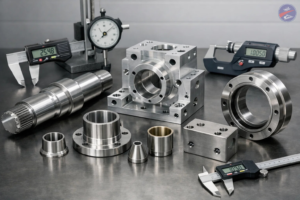
To deliver tight tolerances and surface finishes, manufacturers rely on a combination of:
- CNC machining centres
- Coordinate metrology systems
- Advanced CAD-CAM programming
- Tool path optimization
- Process capability studies
Digital manufacturing and Industry 4.0 technologies are not far behind. Predictive maintenance, digital twins, and automated inspection systems are already making their way into aerospace and defence ecosystems.
For customers, this means reduced cycle times, improved repeatability, and greater confidence in supplier reliability. For India, it represents a leap in global competitiveness.
The Defence & Aerospace Opportunity in India
India has one of the world’s largest defence modernization pipelines, spanning missiles, aircraft, naval platforms, vehicles, avionics, land systems, and electronics. The growth of defence manufacturing is backed by long-term policy frameworks and OEM partnerships.
Similarly, the civil aerospace sector is booming due to:
- Record commercial aircraft orders
- MRO investments
- Drone and UAV development
- Private space exploration programs
In both cases, there is a rapidly growing need for indigenous:
- Shaft assemblies
- Bush and linkage components
- Structural housings
- Actuator matching components
- Mounting blocks and brackets
- Fabricated subsystems
This has opened unprecedented opportunities for manufacturing SMEs with strong quality assurance, machining, and prototyping capabilities.
A Connected Vision for India’s Future
The role of precision suppliers goes beyond making parts — it is about building national capability. Every component produced locally is one less dependency on imports. Every validated process builds supplier maturity. Every partnership with OEMs adds to indigenous IP creation.
By participating in these industrial ecosystems, companies like Vaani Precision Industries contribute directly to:
- Reducing import dependency
- Increasing strategic autonomy
- Creating skilled jobs
- Building long-term industrial capacity
- Supporting India’s ambitions in “Make for the World”
The journey ahead will be shaped by collaboration across government, PSUs, private OEMs, and Tier-1 vendors. But the foundation will remain the same — strong domestic manufacturing capability rooted in quality, precision, and compliance.
Conclusion
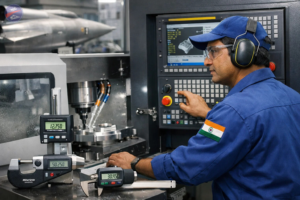
As India strengthens its position in defence, rail, and aerospace sectors, precision manufacturing will continue to be the backbone of progress. It enables the engineering accuracy, safety, and performance required in mission-critical environments.
With advanced machining infrastructure, quality systems, and sectoral experience, Vaani Precision Industries represents the kind of domestic capability India needs to build resilient supply chains and export-ready industrial ecosystems.
The future belongs to countries that can design, manufacture, certify, and sustain complex systems by themselves. India is on that path — and precision-driven enterprises are leading the way.