
Can India Build a Globally Competitive Precision Manufacturing Ecosystem?
Introduction
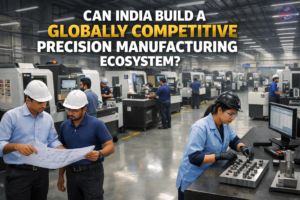
India is rapidly transforming into a country driven by design, engineering, and indigenous production. From new aerospace platforms to modern defence systems and advanced locomotive programs, the nation is investing heavily in strategic industries that rely on highly engineered components. This brings us to an important question for stakeholders, engineers, and policymakers alike:
Can India build a globally competitive precision manufacturing ecosystem?
To answer it, we must evaluate not only national policy and market readiness, but also the maturity of suppliers providing high-accuracy machining, certified materials, and component validation — because this is where true engineering strength resides.
Companies like Vaani Precision Industries, established in 2005, represent how India’s industrial base is evolving from generic job shops into specialized, quality-driven machining and fabrication partners for critical sectors. Their work across railways, defence, automotive, and aerospace shows that the foundation for a competitive ecosystem is already in motion.
Why Precision Matters in Strategic Engineering?
Precision in engineering is not simply about machines cutting metal to small tolerances — it is about creating reliable, repeatable, and compliant solutions that integrate into larger systems. Whether we look at an aircraft linkage, a missile subsystem, or a braking assembly in a freight locomotive, every part must perform under real-world stresses with consistency.
This is why precision manufacturing is considered a backbone capability for modern industrial nations. It enables:
- Accurate dimensional tolerances
- Repeatable batch quality
- Material performance integrity
- Controlled surface finishes
- Application-specific reliability
- Inspection and documentation discipline
For sectors like aerospace machining and defence components, these factors are mandatory, not optional.
India’s Industry Landscape: Opportunities & Challenges
India has one of the world’s fastest-growing markets in terms of defence acquisition, passenger aviation, rail modernization, and heavy automotive production. However, global competitiveness requires more than demand — it requires disciplined supplier ecosystems.
Some of India’s key advantages include:
- Strong engineering education base
- Expanding aerospace and defence budgets
- Government policies aligned with self-reliance
- Growing MSME participation in high-value manufacturing
- Adoption of CNC machining and digital fabrication technologies
On the other hand, challenges remain in areas such as international certification, process audits, and export-grade compliance. This is where niche precision suppliers are making progress by investing in modern machines, skilled operators, and inspection systems that meet the expectations of regulated industries.
Role of Suppliers in Building National Capability
To build a competitive ecosystem, India needs suppliers who can consistently deliver high-accuracy components from certified materials using controlled processes. Manufacturers like Vaani Precision Industries contribute to this goal by operating across multiple phases of the product cycle, including:
- Drawing interpretation
- CAD/CAM programming
- CNC machining
- Fabrication and assembly
- Material traceability
- Dimensional inspection
- Surface finish compliance
- Testing and validation
- Controlled packaging and dispatch
This integrated approach allows customers in strategic sectors to rely on domestic suppliers rather than import similar systems from abroad.
Sectoral Impact: Defence, Aerospace, and Railways
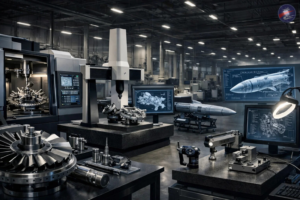
A truly competitive precision ecosystem must serve sectors where mechanical failure is not an option. Let’s examine three critical areas:
- Defence Engineering
Modern defence platforms — ranging from land systems to unmanned vehicles — require components such as linkages, bushings, housings, and structural assemblies. The performance of these defence components depends not just on geometry but also on material behavior, metallurgical quality, shock resistance, and fatigue life.
Indian manufacturers have demonstrated significant progress in machining hardened steels, stainless alloys, and EN-series materials, validating the feasibility of domestic production.
- Aerospace Platforms
Aerospace machining involves producing parts that operate under vibration, aerodynamic loads, and thermal variation. Machined housings, brackets, actuator interfaces, and mountings often demand micronic tolerances and controlled finishes.
While India is still expanding its aerospace supplier certification base, companies with proven machining and inspection capability are helping bridge this gap.
- Railway Systems
Locomotive and passenger rolling stock involve safety-critical mechanical assemblies for braking, coupling, and suspension. Manufacturers such as Vaani Precision Industries supply machined and fabricated parts for railway braking systems, motion linkages, and bogie components, supporting national mobility infrastructure.
The common requirement across all three sectors is repeatable precision — made possible through CNC machining, quality systems, and disciplined process workflows.
How Certification and Documentation Influence Competitiveness
No country can scale industrial exports without documentation discipline. Certification and quality frameworks signal trust to integrators, OEMs, and end-users.
Documentation requirements often include:
- Material Test Certificates (MTCs)
- Dimensional inspection reports
- Heat treatment verification
- Hardness and roughness testing
- Batch traceability logs
- Operator and process records
Domestic machining firms are increasingly adopting these systems, helping India inch closer to global compliance norms and export readiness. The more suppliers implement structured documentation, the stronger India becomes as a precision hub.
Technology Adoption: A Key to Global Competitiveness
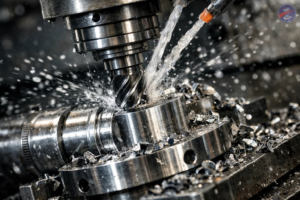
When examining whether India can build a competitive ecosystem, technology is central to the discussion. CNC machining, CAD/CAM, simulation, digital probing, coordinate measurement, and controlled fixturing have already improved domestic machining maturity.
Investments in the following areas are now driving capability growth:
- High-speed VMCs
- Multi-axis CNC lathes
- Digital tool path simulation
- 3D measurement and metrology
- Automated welding for fabrication
- Operator skill development programs
These advancements allow companies like Vaani Precision Industries to demonstrate that Indian MSMEs can achieve industrial-grade consistency across production batches.
So, Can India Build a Competitive Precision Ecosystem?
The answer is yes — with continued investment, certification, and collaboration, India can build a globally recognized industrial base for precision manufacturing. The early building blocks are already visible through:
- Mature machining capabilities
- Documented quality systems
- Growing defence and aerospace participation
- Strong national policy support
- Expanding supplier base in CNC machining
The next step involves deeper integration with OEMs, accelerated certification adoption, and export-market penetration.
Conclusion
Precision is more than machining — it is a culture of discipline, quality, and engineering responsibility. If India is to lead in defence platforms, commercial aerospace, and advanced mobility, companies like Vaani Precision Industries will play a crucial role in making that vision real.
With nearly two decades of sectoral experience, combined machining and fabrication capability, and a quality-first manufacturing philosophy, Vaani Precision Industries represents the kind of domestic competence India needs to answer the industry’s biggest question with confidence:
Yes — India can build a globally competitive precision manufacturing ecosystem.