
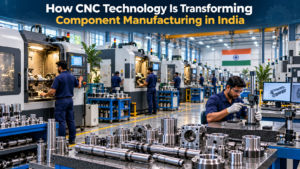
The manufacturing landscape in India is changing rapidly. Increasing demand from automotive, railway, aerospace, defence, agriculture, and industrial sectors is encouraging manufacturers to adopt more advanced production technologies.
One of the technologies playing an important role in this transformation is Computer Numerical Control, commonly known as CNC.
Modern CNC systems allow manufacturers to produce complex parts with repeatable dimensions, consistent quality, and greater production efficiency. For cnc manufacturing companies in India, the adoption of advanced machining technology has become an important part of remaining competitive in an increasingly demanding industrial environment.
But CNC technology is about much more than automated machines. It combines digital design, engineering knowledge, machine control, material selection, inspection, and process management to create reliable industrial parts.
What Is CNC Manufacturing?
CNC manufacturing uses computer-controlled equipment to perform machining operations according to programmed instructions.
Instead of manually controlling every movement of a machine, engineers create digital instructions that determine how the cutting tools should move, where material should be removed, and how the final component should be produced.
Depending on the application, CNC equipment can perform operations such as:
- Milling
- Turning
- Drilling
- Threading
- Boring
- Facing
- Contouring
- Finishing
This level of automation allows manufacturers to produce repeatable parts and components for different industrial applications.
The Role of VMC and CNC Machines
VMC and CNC machines are widely used for producing components that require accurate dimensions and repeatable machining processes.
A Vertical Machining Center, or VMC, is particularly useful for milling operations where multiple features need to be produced on a component.
CNC turning machines, meanwhile, are commonly used for cylindrical components such as shafts, bushes, pins, sleeves, and similar parts.
The combination of these technologies allows manufacturers to handle different component geometries and production requirements efficiently.
For industries that require large quantities of consistent components, automated machining can significantly improve production repeatability.
Why CNC Technology Matters for India’s Manufacturing Industry
The manufacturing industry in India is becoming increasingly technology-driven.
Businesses across different sectors need suppliers that can deliver components consistently while maintaining production schedules and quality requirements.
CNC technology contributes to this transformation in several ways.
1. Better Repeatability
Once a machining process has been properly programmed and validated, the same production parameters can be repeated across multiple components.
This is particularly important when hundreds or thousands of similar parts are required.
2. Improved Productivity
Automated machining reduces the amount of manual intervention required during production.
Machines can perform repetitive operations efficiently, allowing engineering teams to concentrate on programming, inspection, process improvement, and production management.
3. Complex Component Production
Modern CNC equipment can manufacture components with intricate geometries that would be difficult to produce using conventional machining methods.
This is particularly useful for industries where components have specialized shapes or demanding dimensional requirements.
4. Consistent Quality
Consistency is one of the major advantages of computer-controlled manufacturing.
Combined with proper inspection procedures, CNC production can help manufacturers maintain dimensional consistency across production batches.
CNC Applications Across Major Industries
CNC technology has applications across a wide range of engineering industries in India.
Automotive Manufacturing
Automotive manufacturers require a wide variety of components, including shafts, brackets, housings, bushes, connectors, and other mechanical parts.
Because vehicles contain numerous interconnected systems, component dimensions and consistency are important for reliable assembly and operation.
CNC production allows manufacturers to produce automotive parts according to defined engineering specifications.
Railway Components
The railway industry requires durable components capable of operating under demanding conditions.
Rail component manufacturers may produce various machined parts used in railway equipment, assemblies, maintenance systems, and infrastructure-related applications.
Accuracy, material selection, inspection, and repeatability are particularly important because railway components can have direct implications for operational reliability.
This is one reason manufacturers serving railway applications increasingly rely on advanced machining and inspection technologies.
Aerospace and Defence
The defence and aerospace industry represents one of the most demanding manufacturing environments.
Components may need to meet strict dimensional, material, and quality requirements while performing reliably in challenging operating conditions.
CNC technology provides manufacturers with the ability to produce complex metal components while maintaining controlled machining processes.
For aerospace and defence applications, however, machining capability alone is not enough. Proper quality systems, inspection procedures, skilled personnel, and process control are equally important.
Agricultural Machinery
Agricultural equipment operates in demanding environments where components are exposed to dust, vibration, loads, and continuous mechanical stress.
Manufacturers producing tractor and agricultural machinery parts require dependable production processes for items such as shafts, bushings, housings, pins, and other mechanical components.
The use of CNC technology can help achieve consistent dimensions across these components.
From Digital Design to Finished Component
Modern component manufacturing involves several stages.
A typical workflow may include:
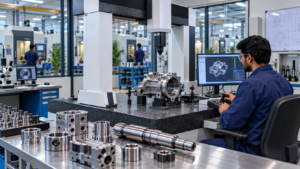
Engineering Design → CAD Model → CAM Programming → CNC Machining → Inspection → Finishing → Final Quality Check
Each stage contributes to the final product.
CAD Design
Engineers create a digital representation of the component.
CAM Programming
The design is converted into machine instructions that determine machining movements and operations.
CNC Production
The programmed machine removes material according to the defined manufacturing process.
Inspection
Finished components are measured using appropriate inspection equipment to verify dimensions and quality.
This integrated approach helps manufacturers maintain better control over production.
The Importance of Quality Inspection
Technology can improve production, but quality inspection remains essential.
Manufacturers need to verify that components meet their required specifications before they reach the customer.
Depending on the component, inspection may involve:
- Vernier calipers
- Digital micrometers
- Gauges
- Height gauges
- Coordinate Measuring Machines
- Surface measurement equipment
- Visual inspection
For industries such as aerospace, defence, automotive, and railways, accurate inspection becomes especially important.
A well-designed quality process helps identify dimensional deviations early and reduces the possibility of defective components entering later stages of production.
Sustainability and Modern Manufacturing
Technology is also changing how manufacturers approach resource efficiency.
Modern production facilities can use digital systems to monitor machining processes, reduce unnecessary material consumption, optimize production cycles, and improve machine utilization.
Manufacturers are increasingly looking for ways to combine productivity with responsible resource management.
This can include:
- Reducing material waste
- Optimizing cutting processes
- Improving machine utilization
- Recycling suitable materials
- Reducing unnecessary production cycles
- Using energy-efficient equipment
As India’s industrial sector grows, sustainable manufacturing practices are likely to become increasingly important.
Choosing the Right Manufacturing Partner
Businesses looking for a component supplier should evaluate more than machinery alone.
Some important considerations include:
Manufacturing Capability
Does the supplier have the equipment required for the component’s geometry and material?
Quality Systems
How are components inspected and documented?
Engineering Expertise
Can the manufacturer understand technical drawings and production requirements?
Production Capacity
Can the supplier handle both initial requirements and future increases in demand?
Industry Experience
Does the manufacturer understand the requirements of automotive, railway, aerospace, defence, agriculture, or other relevant industries?
Communication
Is technical information communicated clearly throughout the production process?
These factors can help businesses identify suitable cnc manufacturing companies in India for long-term requirements.
Vaani Precision Industries and Modern Component Manufacturing
Vaani Precision Industries focuses on manufacturing components for diverse industrial applications, combining modern machining technologies with engineering expertise and quality-focused production processes.
The company’s capabilities support requirements across sectors including automotive, railway, aerospace, defence, agriculture, and industrial manufacturing.
As industrial requirements continue to evolve, manufacturers need to combine technology with skilled people, effective inspection, and continuous process improvement.
This combination can help Indian manufacturers serve increasingly demanding domestic and international markets.
Conclusion
CNC technology is becoming an increasingly important part of India’s manufacturing transformation.
From automotive and agricultural machinery to railway, aerospace, defence, and industrial applications, advanced machining technologies allow manufacturers to produce reliable components with greater consistency and efficiency.
However, successful manufacturing depends on more than machines. Engineering knowledge, process control, inspection, skilled professionals, and continuous improvement all contribute to the final result.
As the manufacturing industry in India continues to develop, companies that combine modern technology with strong engineering and quality practices will be well positioned to support the next generation of industrial growth.