
Introduction
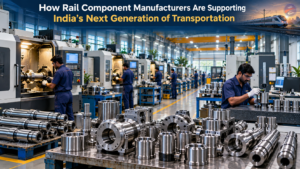
India’s transportation infrastructure is undergoing continuous development. New railway projects, modernization programs, industrial transportation systems and increasing demand for reliable mobility are creating new requirements for accurately manufactured mechanical parts.
Behind every railway system are numerous components that must work together reliably. Wheels, shafts, bushes, pins, housings, brackets, fasteners and other mechanical items all contribute to the performance of larger assemblies.
This is where rail component manufacturers play an important role.
Modern rail component manufacturers are expected to provide more than basic machining services. They need to understand engineering drawings, material specifications, dimensional requirements, production volumes and inspection procedures.
For railway companies and OEMs, choosing capable rail component manufacturers can therefore have a direct impact on production consistency and supply-chain reliability.
The growing capabilities of India’s engineering sector are also allowing manufacturers to support requirements across railway, automotive, agricultural, industrial, aerospace and defence applications.
Why Railway Manufacturing Requires Precision
Railway equipment operates under demanding conditions. Components can experience vibration, repeated movement, mechanical loads and environmental exposure throughout their service life.
Because railway assemblies contain many interconnected parts, dimensional consistency is particularly important.
A small dimensional variation in one component can affect how another component fits or operates.
For this reason, rail component manufacturers need to maintain controlled production processes from raw material selection through machining and final inspection.
Important considerations can include:
- Material grade
- Component dimensions
- Tolerances
- Surface finish
- Thread specifications
- Mechanical requirements
- Production quantity
- Inspection requirements
- Documentation
- Repeatability
Experienced rail component manufacturers understand that producing a sample successfully is only one part of the manufacturing process. The larger challenge is reproducing the same specifications consistently across future production batches.
The Role of CNC Machining in Railway Components
CNC machining has become an important technology for producing complex and repeatable metal components.
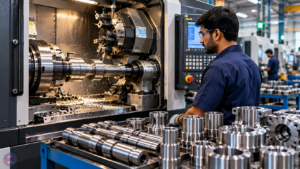
For rail component manufacturers, CNC turning and milling can support the production of components with accurately controlled dimensions.
CNC turning is particularly useful for rotational parts such as shafts, bushes, pins and sleeves. Milling operations can be used when components require slots, holes, pockets, flat surfaces or other geometries.
Modern CNC equipment can reduce dependence on manual machining and provide repeatable production when the process is properly programmed and controlled.
This makes CNC machining particularly useful for rail component manufacturers working on recurring production requirements.
However, machine capability alone does not determine manufacturing quality. Tool selection, workholding, programming, material condition, cutting parameters and inspection all influence the finished component.
Understanding the Components of CNC Lathe Machine Systems
Procurement and engineering teams working with rail component manufacturers can benefit from understanding the basic components of CNC lathe machine systems.
A CNC turning machine typically includes several major elements.
1. Headstock
The headstock contains important spindle and drive mechanisms and provides the main rotational system for the workpiece.
2. Spindle
The spindle rotates the workpiece at a programmed speed. Stable spindle operation is important for consistent turning results.
3. Chuck
The chuck holds the workpiece securely during machining. Proper workholding helps maintain dimensional stability.
4. Turret
The turret holds multiple cutting tools and allows different machining operations to be performed efficiently.
5. Tool Holders
Tool holders secure cutting tools and maintain their position during machining.
6. Tailstock
A tailstock may be used to support longer workpieces where additional stability is required.
7. Machine Bed
The machine bed provides structural support for the major machine elements.
8. CNC Control System
The control system interprets programmed instructions and coordinates machine movements.
Understanding the components of CNC lathe machine equipment can help buyers ask better questions when evaluating rail component manufacturers.
Instead of simply asking how many machines a supplier owns, procurement teams can investigate whether the equipment is appropriate for the required component geometry, material and production volume.
What Should You Look for in Rail Component Manufacturers?
There can be significant differences between suppliers offering apparently similar machining services.
When comparing rail component manufacturers, buyers should consider the complete manufacturing process rather than focusing only on price.
Engineering Capability
A supplier should be able to understand technical drawings, CAD information, tolerances and production specifications.
This is particularly important when a railway component has several critical dimensions or complex features.
Production Capability
The manufacturing facility should have machinery appropriate for the required component.
Depending on the project, this may include CNC turning, milling, VMC machining, drilling and other processes.
Inspection Capability
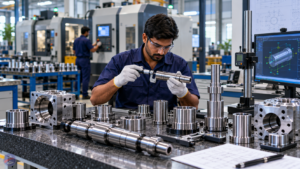
Inspection is essential for verifying whether manufactured components conform to specifications.
A capable supplier may use:
- Vernier calipers
- Micrometers
- Bore gauges
- Height gauges
- Thread gauges
- Digital measuring instruments
- Coordinate Measuring Machines
For rail component manufacturers, inspection should not be considered only a final-stage activity.
First-piece inspection and in-process checks can help identify problems before large quantities are produced.
Why Repeatability Matters in Railway Supply Chains
Railway manufacturers frequently require components in recurring quantities.
This means a supplier must be able to reproduce the same specifications across multiple production cycles.
For rail component manufacturers, repeatability depends on several factors:
- Stable machining processes
- Controlled machine parameters
- Consistent raw materials
- Appropriate tooling
- Process documentation
- Regular inspection
- Skilled operators
- Effective quality control
A supplier that produces an excellent first batch but struggles with repeat orders may not be suitable for a long-term railway supply relationship.
Therefore, businesses evaluating rail component manufacturers should ask about their ability to maintain consistency over time.
Material Selection and Component Performance
The performance of a railway component begins with selecting an appropriate material.
Different applications can require different engineering materials depending on strength, wear resistance, corrosion resistance, machinability and operating conditions.
A supplier should therefore understand the relationship between material selection and manufacturing requirements.
For example, changing material grades can affect machining parameters, tooling requirements and surface characteristics.
Experienced rail component manufacturers can work with engineering teams to ensure that manufacturing processes are aligned with the specified material and component requirements.
Material documentation and traceability can also become important where projects require controlled sourcing.
Quality Inspection Is Part of Manufacturing
One of the biggest misconceptions in machining is that quality is created entirely by the machine.
In reality, quality depends on the complete production process.
A modern manufacturing workflow may include:
Technical drawing → Material preparation → Machine setup → First-piece inspection → Production → In-process inspection → Final inspection → Dispatch
This approach allows manufacturers to identify dimensional deviations at different stages.
For rail component manufacturers, quality inspection can help verify:
- Overall dimensions
- Bore dimensions
- Shaft diameters
- Thread specifications
- Flatness
- Surface characteristics
- Critical tolerances
- Component geometry
The exact inspection method should always depend on the engineering requirements of the component.
Lessons From the Defence and Aerospace Industry
The defence and aerospace industry provides another useful example of why manufacturing discipline matters.
Components used in the defence and aerospace industry may require strict dimensional control, material specifications, repeatability and detailed inspection.
Although railway components have their own specific requirements, the manufacturing principles are often similar.
Both industries can benefit from:
- Controlled machining processes
- Accurate measurement
- Engineering documentation
- Material control
- Repeat production
- Process discipline
- Technical communication
The defence and aerospace industry therefore demonstrates how manufacturing organizations can develop strong quality-oriented production systems.
For rail component manufacturers, adopting similarly disciplined approaches can help improve manufacturing consistency.
From Railway Components to Other Industrial Applications
The same machining capabilities used by rail component manufacturers can often support other industries.
Automotive manufacturers require shafts, bushes, pins, housings and sleeves.
Agricultural machinery requires durable mechanical parts for tractors and other equipment.
Industrial machinery requires accurately manufactured components for assemblies and production equipment.
The defence and aerospace industry requires components manufactured according to demanding engineering specifications.
This diversity allows manufacturing companies to develop expertise across multiple engineering applications.
However, each industry still requires application-specific evaluation. A component suitable for one machine should not automatically be assumed to be suitable for another.
How to Identify the Best Precision Components Provider
Many businesses search for the best precision components provider when beginning a new manufacturing project.
However, the best precision components provider is not necessarily the supplier with the lowest quotation or the largest machine list.
Instead, buyers should determine whether the supplier can meet their actual technical requirements.
Consider the following factors:
Technical Understanding
Can the supplier interpret engineering drawings and understand critical dimensions?
Machine Capability
Does the facility have appropriate turning, milling or VMC equipment?
Quality Systems
Does the supplier have suitable inspection equipment and quality-control procedures?
Production Capacity
Can the supplier manage both initial quantities and future repeat requirements?
Material Capability
Can the required materials be sourced, processed and documented appropriately?
Communication
Can the engineering and production teams communicate effectively when specifications change?
Delivery
Can the supplier maintain realistic production schedules?
These factors provide a more practical way of identifying the best precision components provider for a specific project.
Vaani Precision Industries and Industrial Component Manufacturing
Vaani Precision Industries operates in the industrial manufacturing sector and supports requirements involving machined and fabricated metal components.
Its applications extend across areas such as railway, automotive, agriculture, aerospace, defence and general engineering.
For businesses looking for rail component manufacturers, evaluating actual manufacturing and inspection capabilities is more useful than relying solely on promotional claims.
Vaani Precision Industries can be assessed according to factors such as machining capabilities, engineering understanding, quality inspection and the ability to support recurring production requirements.
The same approach applies when companies are searching for the best precision components provider for automotive, industrial or other engineering applications.
Questions Buyers Should Ask Before Selecting a Supplier
Before placing an order with rail component manufacturers, procurement teams can ask several practical questions.
Can you manufacture directly from our technical drawing?
This helps determine whether the supplier understands the required dimensions and specifications.
What CNC machining capabilities are available?
Understanding the available equipment helps determine whether the supplier can manufacture the required geometry.
What inspection equipment do you use?
The answer can indicate how dimensional quality is controlled.
Can you support repeat production?
Railway supply chains often require recurring quantities.
What materials can you process?
Material capability should match the engineering requirements.
Can you provide quality documentation?
Documentation may be important for projects requiring traceability and controlled production.
What production volumes can you handle?
Capacity should be evaluated for both current requirements and potential future orders.
These questions can help businesses distinguish between general machining suppliers and rail component manufacturers with capabilities better aligned to their requirements.
The Future of Railway Component Manufacturing in India
India’s expanding industrial ecosystem is creating opportunities for domestic manufacturing companies to participate in increasingly sophisticated supply chains.
Technology will continue to influence how components are designed, manufactured and inspected.
CNC machining, VMC systems, digital measurement, automation and improved production planning can all contribute to more consistent manufacturing.
At the same time, skilled engineering professionals will remain essential.
Machines can execute programmed operations, but engineers are responsible for interpreting requirements, selecting appropriate processes, identifying manufacturing challenges and maintaining quality standards.
For rail component manufacturers, the future will therefore involve a combination of technology, engineering expertise and disciplined production processes.
The defence and aerospace industry also demonstrates how strong quality systems and controlled manufacturing can support demanding applications.
Conclusion
The railway sector depends on a large network of accurately manufactured mechanical components.
As India’s transportation infrastructure continues to develop, the role of rail component manufacturers will become increasingly important.
Modern suppliers need to combine CNC machining, engineering knowledge, material understanding and quality inspection to support demanding production requirements.
Understanding the components of CNC lathe machine systems can help buyers evaluate machining capabilities more effectively, while understanding quality-control practices can help them assess production reliability.
The defence and aerospace industry further demonstrates the importance of controlled manufacturing, inspection and repeatability.
Ultimately, selecting the best precision components provider requires looking beyond price. Technical capability, manufacturing consistency, inspection infrastructure, communication and long-term supply reliability should all be considered.
For businesses seeking reliable manufacturing support, Vaani Precision Industries represents one option to evaluate based on these practical engineering and production criteria.