
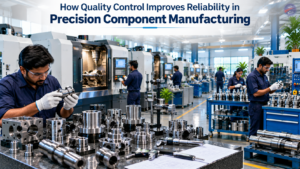
Modern industries increasingly depend on components that must perform accurately, consistently, and reliably under demanding operating conditions. From automotive assemblies and agricultural machinery to railway equipment, aerospace applications, and industrial systems, the quality of individual components can directly influence the performance of an entire machine.
This is where precision component manufacturing becomes important.
Precision manufacturing is not simply about producing a metal part according to a drawing. It involves controlling dimensions, tolerances, materials, machining processes, surface characteristics, and inspection procedures throughout production. A strong quality-control system ensures that every stage of manufacturing contributes to a consistent final product.
For manufacturers and procurement teams, understanding the relationship between machining and quality control can make supplier selection and production planning much more effective.
What Is Precision Component Manufacturing?
Precision component manufacturing is the process of producing mechanical parts to specific dimensional and engineering requirements using controlled manufacturing methods.
Depending on the component, production may involve CNC turning, VMC machining, drilling, milling, grinding, threading, deburring, finishing, and other processes.
Typical products can include:
- Shafts
- Bushes
- Pins
- Housings
- Sleeves
- Spacers
- Mechanical fittings
- Custom machined components
- Industrial assemblies
The objective is to manufacture precision engineered components that can consistently meet the requirements specified in engineering drawings.
Even a small dimensional variation in a critical component can affect assembly, movement, alignment, or operational performance. Therefore, manufacturing accuracy must be supported by systematic inspection.
Why Quality Control Matters in Manufacturing
Quality control helps manufacturers identify deviations before components reach the customer or become part of a larger assembly.
A comprehensive quality-control process can help address:
Dimensional Accuracy
Critical dimensions need to remain within the specified tolerance range. Measurement tools such as micrometers, vernier calipers, gauges, and digital instruments can be used according to the component’s requirements.
Consistency Between Batches
Producing one accurate component is not enough for industrial production. Customers often require hundreds or thousands of components with consistent dimensions.
Quality control helps monitor production so that variations between batches can be identified and addressed.
Material Verification
The material used for a component can influence strength, durability, machinability, and service life. Depending on the application, material identification and documentation can therefore be an important part of quality management.
Process Stability
Quality inspection is not limited to the final component. Monitoring machining parameters and production processes can help identify problems earlier.
This is particularly important when producing precision engineered components for demanding industrial applications.
The Role of CNC Machining in Quality Manufacturing
Modern CNC technology has significantly improved manufacturing repeatability.
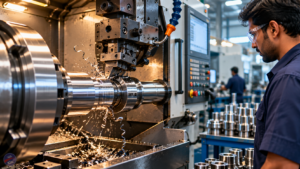
A VMC and CNC machine can execute programmed machining operations with a high degree of consistency when the machine, tooling, workholding, programming, and process parameters are properly controlled.
CNC machining can be used for:
- Turning cylindrical components
- Milling complex profiles
- Creating holes and slots
- Producing threads
- Machining housings
- Manufacturing shafts and bushes
- Creating repeatable component features
However, CNC technology alone does not guarantee quality.
Tool wear, incorrect offsets, material variation, machine condition, programming errors, and improper workholding can still affect the finished component. This is why machining must be combined with inspection and process monitoring.
Quality Inspection During Production
One of the strongest approaches to quality management is to inspect components at different stages rather than waiting until the end of production.
A typical process may include:
Raw material → Machining → In-process inspection → Finishing → Final inspection → Packaging
In-process inspection allows engineers to identify deviations while production is still underway.
For example, if a cutting tool begins to wear and causes a diameter to move outside the desired range, early inspection can reveal the issue before a large batch is affected.
This approach can reduce material waste, rework, and production interruptions.
Importance of Measuring Precision Engineered Components
Different components require different inspection methods.
A cylindrical shaft may require diameter and length measurements, while a housing may require checks for multiple dimensions, holes, depths, and alignment characteristics.
Common inspection equipment includes:
- Micrometers
- Vernier calipers
- Height gauges
- Bore gauges
- Plug gauges
- Thread gauges
- Digital measuring instruments
- Coordinate measuring equipment where required
For precision component manufacturing, selecting an appropriate inspection method is just as important as selecting the machining process.
The inspection method should be suitable for the component’s geometry, tolerance, material, and intended application.
From Raw Material to Finished Component
Quality begins before machining starts.
A structured manufacturing process considers the material, drawing specifications, tooling requirements, machine capability, inspection requirements, and finishing process.
Step 1: Reviewing Technical Requirements
Engineers study drawings and specifications to understand critical dimensions and tolerances.
Step 2: Material Preparation
Suitable raw material is selected and prepared according to production requirements.
Step 3: CNC Machining
The component undergoes turning, milling, drilling, or other machining operations.
Step 4: In-Process Inspection
Critical features are checked during production.
Step 5: Finishing
Deburring, surface treatment, grinding, or other finishing operations may be performed depending on requirements.
Step 6: Final Inspection
Finished precision engineered components are inspected before dispatch.
This structured approach helps manufacturers maintain greater consistency across production batches.
Quality Control Across India’s Manufacturing Sector
The manufacturing industry in India is becoming increasingly dependent on advanced production capabilities, engineering skills, automation, and quality-focused processes.
Indian manufacturers supply components to a wide range of sectors, including:
- Automotive
- Railways
- Agriculture
- Aerospace
- Defence
- Industrial machinery
- Heavy engineering
- General engineering
As industrial supply chains become more demanding, manufacturers increasingly need to demonstrate not only production capacity but also process reliability.
For companies purchasing parts and components, evaluating a supplier’s inspection practices can therefore be as important as evaluating its machining equipment.
How Quality Control Reduces Manufacturing Risk
Poor-quality components can create problems beyond the manufacturing floor.
A dimensional issue may result in:
- Assembly difficulties
- Increased rework
- Production delays
- Higher rejection rates
- Premature component wear
- Customer complaints
- Additional inspection costs
A reliable quality-control system helps reduce these risks.
For precision component manufacturing, the objective should be to prevent defects rather than simply identify them after production.
This requires communication between design, production, quality, and procurement teams.
The Importance of Skilled Engineers
Advanced machinery provides manufacturing capability, but skilled engineers remain essential for maintaining quality.
Engineers interpret drawings, select suitable machining strategies, monitor production, inspect components, identify deviations, and make process improvements.
Their experience becomes particularly valuable when manufacturing precision engineered components with complex geometries or tight tolerances.
A combination of modern equipment and engineering expertise can create a more reliable production environment.
Quality Control and Manufacturing and Fabrication
Quality control is also important in manufacturing and fabrication activities where multiple processes may be involved.
Fabricated assemblies can contain welded, machined, drilled, or finished elements. Each operation can influence the final assembly.
For this reason, inspection should not be considered an isolated department function. Quality needs to be integrated into the entire production workflow.
When machining and fabrication processes are properly coordinated, manufacturers can achieve better dimensional consistency and assembly performance.
Choosing a Manufacturing Partner
Companies sourcing industrial components should evaluate more than pricing when selecting a manufacturing partner.
Important factors include:
- Machining capability
- Available CNC and VMC equipment
- Inspection facilities
- Engineering experience
- Material handling
- Production capacity
- Process consistency
- Documentation and traceability
- Delivery performance
- Ability to manufacture according to drawings
A supplier capable of producing precision engineered components consistently can provide greater value than a supplier selected only because of a lower initial quotation.
Why Process Consistency Matters
For industrial customers, consistency is often more important than producing an occasional excellent component.
Imagine receiving a batch of 1,000 components where most parts meet specifications but a small percentage have dimensional deviations. Those rejected parts can interrupt assembly operations and increase overall production costs.
A strong precision component manufacturing process therefore focuses on repeatability.
Machine maintenance, tooling management, process monitoring, operator training, and inspection all contribute to this objective.
Vaani Precision Industries and Precision Manufacturing
Vaani Precision Industries focuses on precision engineering and manufacturing solutions for industrial requirements.
By combining CNC machining capabilities, engineering expertise, production processes, and quality inspection practices, the company supports the manufacture of components used across sectors such as automotive, railway, agriculture, aerospace, defence, and general engineering.
The focus on process control and inspection helps ensure that manufactured components are produced according to defined technical requirements.
For businesses looking for a manufacturing partner, evaluating technical capability together with quality systems provides a more complete understanding of a supplier’s ability.
Conclusion
Quality control is a fundamental part of modern precision component manufacturing. Producing reliable components requires more than advanced machinery. It requires accurate drawings, suitable materials, controlled machining processes, skilled engineers, appropriate inspection equipment, and consistent production practices.
As the manufacturing industry in India continues to adopt advanced technologies, the importance of process reliability and quality management will continue to grow.
Whether manufacturing shafts, bushes, pins, housings, or other precision engineered components, integrating quality control into every stage of production can help manufacturers reduce defects, improve consistency, and deliver components that perform reliably in their intended applications.
For industrial customers, the right manufacturing partner is therefore one that combines machining capability, engineering knowledge, quality inspection, and process discipline rather than focusing on production volume alone.