
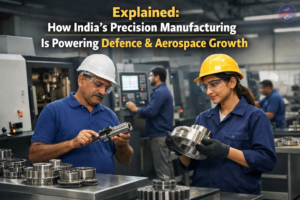
Why Is Precision Manufacturing Suddenly in the Spotlight?
India’s defence and aerospace sectors are undergoing rapid transformation. With the push for Atmanirbhar Bharat and stronger indigenous capability, the country is investing heavily in domestic production.
But large defence systems and aircraft platforms are not built overnight. They require thousands of high-accuracy mechanical parts manufactured with consistency and traceability.
This raises an important question:
Can India’s precision manufacturing ecosystem support the country’s defence and aerospace ambitions?
The answer lies in how domestic manufacturers are upgrading technology, quality systems, and production capability to meet global standards.
What Is Precision Manufacturing?
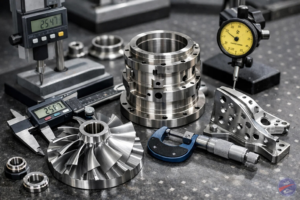
Precision manufacturing refers to the production of high-accuracy components that must meet tight dimensional tolerances, material standards, and performance requirements.
Unlike conventional fabrication, this process focuses on:
- Controlled tolerances
- Surface finish compliance
- Material certification
- Batch traceability
- Repeatable accuracy
- Inspection documentation
Industries such as defence, aerospace, railways, and automotive depend heavily on such capabilities.
Companies like Vaani Precision Industries, established in 2005, operate in this space by supplying machined and fabricated components to strategic sectors across India.
Why Is It Critical for Defence Manufacturing?
India has historically depended on imports for advanced defence systems. However, recent policy reforms are encouraging domestic production to reduce dependency and strengthen supply chain security.
Modern defence platforms require:
- Structural housings
- Bushes and shafts
- Linkage systems
- Fabricated assemblies
- Prototype and validation components
These parts must perform under extreme operational conditions, including vibration, load stress, and temperature variation.
This is where defence manufacturing relies on capable MSMEs. Without a strong domestic supplier base, large system integrators cannot scale production effectively.
How Does Aerospace Add to the Challenge?
Aerospace programs raise the bar even higher. Manufacturing aerospace components involves tight dimensional control, high-grade materials, and strict documentation.
Aircraft and UAV systems demand:
- Micron-level tolerance control
- Smooth surface finishes
- Certified stainless steels and aluminium alloys
- Process traceability
- Batch consistency
The same precision standards that apply in defence often extend into aerospace supply chains, making machining capability and quality systems essential.
What Role Does CNC Machining Play?
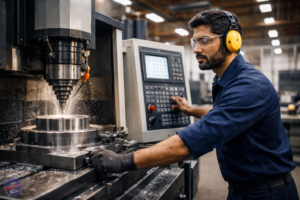
Technology is at the center of this transformation. CNC machining enables manufacturers to produce complex geometries with repeatable accuracy.
Modern machining centers allow:
- Multi-axis cutting
- Digital program simulation
- Controlled tool paths
- High batch consistency
- Efficient material utilization
For manufacturers like Vaani Precision Industries, CNC capability forms the backbone of component production across railways, defence, and aerospace sectors.
What Are the Benefits of a Strong Domestic Manufacturing Base?
A growing precision ecosystem provides multiple advantages to India.
Reduced Import Dependency
Local suppliers reduce reliance on foreign vendors for critical components.
Faster Development Cycles
Domestic production enables quicker prototyping and design iteration.
Economic Value Addition
Manufacturing within India strengthens industrial output and employment.
Supply Chain Security
Domestic sourcing reduces vulnerability during geopolitical disruptions.
Export Potential
As standards improve, Indian manufacturers can integrate into global supply chains.
These benefits highlight why strengthening precision manufacturing is not just an industrial goal but a strategic necessity.
What Challenges Still Exist?
While progress is visible, several hurdles remain.
Certification and Compliance
Global defence and aerospace supply chains require rigorous quality certifications and audit processes.
Capital Investment
Advanced machines, inspection equipment, and skilled workforce development require long-term investment.
Documentation Discipline
Traceability, inspection records, and process validation must align with global expectations.
Long Procurement Cycles
Defence projects often involve extended evaluation and approval timelines.
Indian MSMEs are gradually addressing these challenges through structured quality systems and technology adoption.
How Companies Like Vaani Precision Industries Fit In
Vaani Precision Industries operates across multiple sectors, including railways, defence, and automotive, with expanding participation in aerospace-related components.
The company’s strengths include:
- Advanced machining infrastructure
- Fabrication and assembly capability
- Drawing-based production
- Inspection-focused workflow
- Commitment to on-time delivery
By maintaining process discipline and adapting to industry requirements, such manufacturers help strengthen India’s broader manufacturing ecosystem.
What Does This Mean for India’s Industrial Future?
India’s long-term industrial growth depends on more than policy announcements. It requires execution at the ground level — inside workshops, machining bays, and inspection labs.
As defence procurement becomes more localized and aerospace production expands, demand for high-quality domestic suppliers will rise.
The future will likely see:
- Increased private-sector participation
- Greater integration with global OEMs
- Technology transfer partnerships
- Upgraded certification pathways
- Stronger MSME collaboration networks
The evolution of India’s precision manufacturing ecosystem will determine how successfully the country transitions from a major importer to a global supplier.
Conclusion
India’s defence and aerospace ambitions depend heavily on the strength of its domestic manufacturing base. Precision manufacturing plays a central role in enabling reliable, compliant, and scalable production of mission-critical components.
So, can India’s precision ecosystem support its defence and aerospace growth?
The early signs suggest yes — provided technology adoption, quality discipline, and industry collaboration continue to strengthen.
Manufacturers like Vaani Precision Industries represent the growing capability of Indian MSMEs to contribute meaningfully to national industrial development.
The transformation is underway — and precision is at its core.