
Introduction
India is in the middle of a historic shift in how it builds, procures, and sustains its defence and aerospace capabilities. For decades, the country relied heavily on imports for critical systems and equipment. Today, that model is changing rapidly as the government pushes for Atmanirbhar Bharat and long-term strategic autonomy.
But behind the headlines and large defence contracts lies a deeper and more important industry question:
Can Indian MSMEs become global suppliers in defence manufacturing?
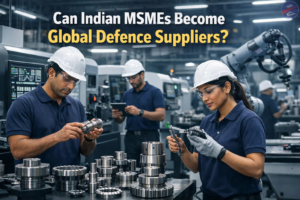
The answer depends not only on large system integrators but also on the growing ecosystem of precision engineering companies that manufacture the thousands of components required for defence and aerospace platforms. Companies like Vaani Precision Industries are part of this transformation, supporting national programs through machining, fabrication, and assembly of high-accuracy engineered parts.
Why India is Rebuilding Its Defence Manufacturing Ecosystem?
India has long been one of the world’s largest defence importers. While imports helped bridge capability gaps, they also created long-term dependence on foreign suppliers. The shift toward domestic production aims to solve three major challenges:
- Strategic independence
- Supply chain security
- Long-term cost efficiency
Government initiatives now actively promote domestic production, technology transfer, and collaboration between public sector units, private companies, and MSMEs. The goal is to build a complete defence manufacturing ecosystem within India.
However, large defence platforms are not built by a single company. They require thousands of individual components manufactured by a network of specialized suppliers.
The Hidden Backbone of Defence Production
A modern defence platform — whether a land vehicle, missile system, or UAV — contains a vast number of mechanical and structural parts. Many of these components are produced by MSMEs specializing in machining and fabrication.
These include:
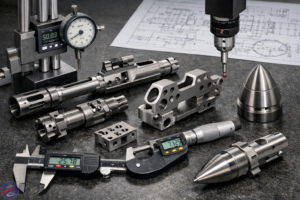
- Precision bushes and shafts
- Structural housings and brackets
- Linkages and motion components
- Fabricated assemblies
- Prototype and development parts
This is where precision machining becomes the backbone of defence production. Without reliable domestic suppliers capable of producing such components to strict specifications, large defence programs cannot scale effectively.
What Makes Defence Manufacturing Different?
Manufacturing for defence applications is fundamentally different from general industrial production. Components must operate in demanding environments involving:
- Extreme temperatures
- Continuous vibration
- Heavy mechanical loads
- Long operational lifecycles
This means suppliers must deliver more than dimensional accuracy. They must ensure:
- Certified material traceability
- Surface finish control
- Batch consistency
- Process documentation
- Inspection and validation
Companies like Vaani Precision Industries follow drawing-based production, controlled workflows, and structured inspection processes to meet these expectations.
How Aerospace Growth Strengthens the Same Ecosystem
Defence and aerospace industries share many engineering characteristics. Both depend heavily on high-accuracy machining and controlled fabrication processes.
Manufacturing aerospace components requires:
- Tight tolerances
- High-quality surface finishes
- Advanced materials
- Process documentation
- Reliable repeatability
Because of this overlap, suppliers experienced in defence engineering can expand into aerospace supply chains. This cross-sector capability strengthens India’s overall manufacturing ecosystem and opens doors to global partnerships.
Benefits of a Strong Domestic Supplier Network
Building a robust MSME ecosystem in defence manufacturing creates long-term advantages for the country.
Reduced Import Dependency
Domestic production strengthens supply chain security and reduces foreign reliance.
Faster Development & Prototyping
Local suppliers enable rapid iteration during design and testing phases.
Cost Optimization
Shorter logistics chains and local sourcing improve cost efficiency.
Job Creation & Skill Development
Precision engineering creates high-skill employment opportunities.
Export Potential
Strong domestic capability enables participation in global defence supply chains.
These benefits show why MSME participation is essential for long-term industrial growth.
The Challenges MSMEs Must Overcome
Despite strong momentum, the journey toward global competitiveness comes with challenges.
Certification & Compliance
International defence and aerospace supply chains require rigorous certifications and audits.
Capital Investment
Advanced machines, metrology equipment, and training demand long-term investment.
Documentation Discipline
Traceability and process documentation must meet global expectations.
Long Procurement Cycles
Defence programs often involve extended timelines and complex approvals.
Indian MSMEs are gradually addressing these challenges through technology adoption and process improvement.
Technology as the Enabler of Competitiveness
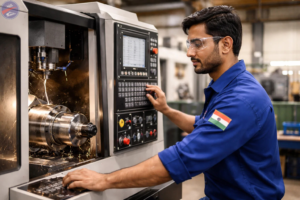
Modern CNC machining has transformed the manufacturing landscape. Today’s machining centers enable high repeatability, complex geometries, and efficient batch production.
Key technological enablers include:
- Multi-axis machining centers
- CAD/CAM programming
- Digital inspection tools
- Advanced fabrication techniques
- Skilled operator training
These technologies allow companies like Vaani Precision Industries to deliver consistent, high-quality output across multiple sectors.
The Road Ahead for Indian MSMEs
India’s defence roadmap includes increasing domestic sourcing, strengthening private sector participation, and expanding exports. As the ecosystem matures, the role of precision engineering suppliers will become even more critical.
The next decade will likely bring:
- Greater collaboration with global OEMs
- Expansion of aerospace manufacturing
- Increased technology transfer
- Stronger export participation
This growth will depend heavily on the capability and reliability of domestic precision manufacturers.
Conclusion
India’s defence self-reliance journey is not driven by large companies alone. It is powered by a network of precision engineering firms that supply the essential components enabling complex systems to function.
So, can Indian MSMEs become global suppliers in defence manufacturing?
The answer is yes — through continued investment, technology adoption, and collaboration. Companies like Vaani Precision Industries are helping build the foundation for a resilient, competitive, and self-reliant manufacturing ecosystem.