
Introduction
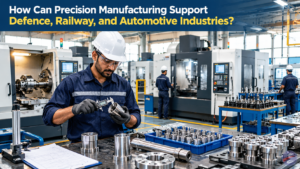
Modern industries depend on components that perform reliably under specific operating conditions. A small dimensional variation in a mechanical part can affect assembly, maintenance, efficiency, or service life. This makes precision engineering an important part of industrial development, particularly in sectors where component consistency and dependable performance are essential.
From railway assemblies and automotive mechanisms to specialized defence equipment, manufacturers must balance dimensional accuracy, material suitability, production efficiency, and quality verification. Achieving these objectives requires more than advanced machinery. It also involves engineering knowledge, controlled manufacturing processes, suitable inspection methods, and effective coordination between suppliers and customers.
Manufacturing and fabrication play complementary roles in this process. Machining produces components with specified geometries and dimensions, while fabrication processes can support the production of structures, assemblies, brackets, and other engineered products.
As industrial supply chains become more demanding, manufacturers that combine technical capability with consistent quality practices can help customers address increasingly complex production requirements.
This article explores how precision manufacturing supports defence, railway, and automotive applications, why sustainable production matters, and what businesses should consider when selecting a manufacturing partner.
1. Why Is Precision Manufacturing Important for Modern Industry?
Precision manufacturing involves producing components according to defined engineering drawings, dimensions, tolerances, material requirements, and surface-finish specifications.
Its importance extends beyond making a part fit correctly. Components may need to withstand repeated movement, vibration, mechanical loads, temperature changes, or challenging operating environments.
A dependable manufacturing process typically involves several interconnected activities:
- Reviewing engineering drawings and specifications.
- Selecting suitable materials and machining processes.
- Planning tooling, workholding, and production sequences.
- Controlling critical dimensions during manufacturing.
- Inspecting finished components against acceptance criteria.
- Maintaining production and inspection records where required.
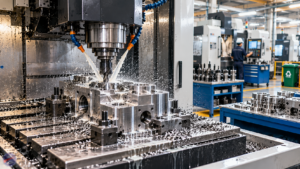
Computer numerical control (CNC) machining supports the production of components through programmed cutting operations. CNC turning is particularly useful for suitable cylindrical components, while vertical machining centres (VMCs) can produce features such as holes, pockets, slots, and machined surfaces.
The appropriate process depends on the component geometry, material, quantity, tolerances, and intended application.
Precision engineering is therefore not simply a question of using sophisticated equipment. It requires the right combination of machine capability, process planning, operator expertise, and quality control.
2. How Does Defence Sector Parts Manufacturing Support Equipment Reliability?
The defence sector uses a wide range of mechanical systems, equipment assemblies, support structures, and specialized components. Their manufacturing requirements vary according to the intended application, operating environment, engineering specifications, and applicable procurement standards.
Defense sector parts manufacturing requires careful attention to material specifications, dimensional requirements, manufacturing documentation, and inspection procedures.
Depending on the application, components may need to withstand vibration, mechanical loading, repeated operation, or exposure to challenging environmental conditions. Manufacturing processes must be selected according to these requirements rather than applied uniformly to every component.
The role of precision machining
CNC turning and VMC machining can produce different types of engineered components when the required geometry falls within the equipment’s capabilities.
Examples of potential applications include:
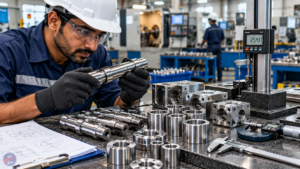
- Precision pins and shafts.
- Machined housings and sleeves.
- Bushes and mechanical interfaces.
- Special-purpose brackets and fixtures.
- Components manufactured to approved engineering drawings.
These examples are illustrative; the actual component requirements depend on the equipment and application.
Material verification and traceability
Material selection can influence component strength, wear behaviour, machinability, and service performance. Manufacturers should follow the specified material grade and verification requirements.
Where required, material certificates, batch identification, inspection results, and production records can help establish traceability. These records are especially useful when a customer needs to investigate a quality issue or verify the manufacturing history of a component.
Inspection throughout production
Final inspection alone may not be sufficient for every application. First-article inspection, in-process checks, and final dimensional verification can help identify deviations at different stages.
The inspection plan should reflect the drawing requirements, component criticality, customer specifications, and applicable quality procedures.
For defence-related manufacturing, the relevant approvals, certifications, security requirements, and procurement conditions must also be confirmed for the specific contract. General machining capability should not be treated as automatic qualification for every defence application.
3. Why Is Railway Sector Parts Manufacturing Essential for Transportation?
Railway systems contain numerous mechanical assemblies that must operate reliably over extended service periods. Depending on the application, components may experience vibration, repeated loading, friction, environmental exposure, and frequent maintenance cycles.
Railway sector parts manufacturing supports the production and maintenance of components used in railway equipment, coach assemblies, mechanical interfaces, and associated systems.
The requirements differ considerably between applications, so manufacturers must work from the relevant engineering drawings and technical specifications.
Dimensional accuracy and component fit
Many railway components interact with other parts in a larger assembly. Incorrect dimensions can create installation difficulties, excessive clearance, interference, or premature wear.
For example, a machined shaft or bush may require specific dimensional and surface-finish characteristics to function correctly with a mating component.
Appropriate CNC machining, grinding, and dimensional inspection can help manufacturers meet these requirements where the processes are suitable.
Repeatability across production batches
Railway projects may require multiple components manufactured to the same specifications. Maintaining consistency between batches is important for assembly, replacement, and maintenance planning.
Manufacturers can improve repeatability by standardizing machine setups, monitoring tooling, controlling process parameters, and checking critical dimensions at appropriate intervals.
When a drawing is revised, the correct revision must be communicated to production and inspection teams to prevent outdated specifications from being used.
Supporting maintenance and replacement requirements
Railway equipment often requires inspection, repair, and replacement of components throughout its service life. Reliable manufacturing processes can help produce replacement parts that meet the relevant technical requirements.
However, railway components must be manufactured and approved according to the applicable specifications. Similar-looking components are not necessarily interchangeable, especially where safety-critical functions are involved.
4. How Can Sustainable Railway Component Manufacturing Reduce Waste?
Sustainability in manufacturing involves more than choosing environmentally preferable materials. It also includes reducing unnecessary material consumption, improving process efficiency, managing waste responsibly, and extending the useful life of suitable products.
Sustainable railway component manufacturing can support these objectives when environmental considerations are integrated into engineering and production decisions.
Improve material utilization
Machining removes material to create the required geometry. Poor process planning can result in unnecessary material removal, excessive scrap, or repeated manufacturing operations.
Manufacturers can review machining sequences, tooling strategies, and component designs to identify opportunities for better material utilization.
Where the engineering requirements permit, suitable near-net-shape processes or alternative manufacturing methods may reduce the amount of material that needs to be removed.
Any proposed design or process change must preserve the component’s required performance and comply with approved specifications.
Extend component service life
A component that performs reliably for its intended service period may require fewer replacements than one that fails prematurely.
Achieving this outcome depends on appropriate material selection, manufacturing quality, operating conditions, maintenance, and correct installation.
Surface finish, dimensional accuracy, and material characteristics can all influence component performance where they are relevant to the application.
Reduce rework and rejected components
Scrapped parts consume materials, machine time, energy, and labour. Rework can also create additional production delays.
Preventive maintenance, suitable first-article inspection, in-process checks, and root-cause analysis can help reduce avoidable defects.
A useful sustainability measure is therefore not just how efficiently a machine operates, but also how much acceptable output is produced from the resources consumed.
Manage manufacturing waste responsibly
Metal chips, used cutting fluids, packaging, and other production waste should be handled according to applicable environmental and safety requirements.
Segregating recyclable materials, managing fluids correctly, and maintaining clean production areas can support better resource management.
Manufacturers should assess sustainability using measurable process data where possible, rather than relying only on broad environmental claims.
5. What Is the Role of Manufacturing and Fabrication in Integrated Production?
Machining and fabrication address different but often complementary manufacturing needs.
Manufacturing and fabrication may be combined when a project requires both accurately machined components and fabricated structures or assemblies.
Machining can produce features such as bores, threaded holes, shoulders, slots, and precision mating surfaces. Fabrication can involve processes such as cutting, forming, welding, and assembling metal sections, depending on the project.
Why coordination matters
When a product includes both machined and fabricated elements, the interface between processes needs careful planning.
For example, a fabricated structure may require machined mounting surfaces or accurately positioned holes. If the fabrication stage introduces distortion or dimensional variation, subsequent machining and assembly may become more difficult.
A coordinated workflow can include:
- Reviewing the complete engineering drawing.
- Identifying fabrication and machining requirements.
- Establishing suitable manufacturing sequences.
- Defining critical dimensions and inspection points.
- Verifying interfaces before final assembly.
- Documenting inspection results where required.
The sequence must be chosen for the actual component. Some parts benefit from machining before fabrication or assembly, while others require machining afterward.
The importance of supplier coordination
Customers should communicate drawing revisions, tolerances, material requirements, finishing specifications, and delivery expectations clearly.
Manufacturers should raise technical questions before production begins rather than making unapproved assumptions.
This collaboration can reduce misunderstandings, avoid unnecessary rework, and improve the predictability of production schedules.
6. How Do Top Automotive Spare Parts Companies in India Maintain Consistency?
India’s automotive supply chain includes manufacturers producing a wide variety of components for vehicle assembly, replacement markets, and industrial applications. Requirements vary between component categories, vehicle systems, customers, and applicable standards.
When businesses research the top automotive spare parts companies in India, they should evaluate more than company size or market visibility. The right supplier depends on the component being sourced and the requirements of the buyer.
Evaluate manufacturing capability
A supplier should have equipment and processes appropriate for the component’s material, geometry, tolerance, and expected production volume.
For machined parts, buyers may need to assess CNC turning, VMC machining, grinding, tooling, workholding, and inspection capabilities.
A supplier’s ability to produce a prototype does not automatically establish its ability to manufacture large batches consistently.
Examine quality practices
Automotive applications may require detailed control over dimensions, materials, process changes, and traceability.
Buyers should clarify which quality standards or customer-specific requirements apply to their components. They should also review inspection procedures, corrective-action practices, and relevant documentation.
Certifications should be checked for their actual scope and validity rather than assumed to cover every product or process offered by a supplier.
Assess production and delivery performance
Manufacturing capability must be matched with realistic production planning.
Questions to consider include:
- Can the supplier meet the required production quantity?
- Are tooling and raw materials available?
- How are changes in production schedules managed?
- What inspection and documentation will accompany deliveries?
- How are defective or nonconforming components handled?
These questions help buyers evaluate the supplier’s suitability for the specific project rather than relying on a generic ranking.
Consider total value, not just price
The lowest quotation may not represent the best long-term value if it is accompanied by inconsistent quality, delivery delays, or limited technical support.
A broader evaluation should consider unit cost, inspection requirements, defect rates, delivery reliability, and communication.
The best supplier is one that meets the required specifications and commercial expectations consistently.
7. How Can CNC and VMC Machining Improve Production Consistency?
CNC and VMC equipment can support repeatable manufacturing by executing programmed operations. However, repeatability still depends on how the process is designed, set up, monitored, and maintained.
Several practices can help:
Standardized setups: Consistent workholding, tooling, and setup procedures reduce avoidable variation between jobs.
Tool-condition monitoring: Cutting tools wear over time. Appropriate inspection and replacement practices help maintain machining performance.
Program verification: CNC programs should be reviewed and validated for the intended machine, tooling, workpiece, and operation.
In-process measurement: Checking critical dimensions during production helps detect deviations before they affect a larger batch.
Preventive maintenance: Machine condition can influence dimensional accuracy, surface finish, and operational availability.
Controlled documentation: Recording relevant inspection results and process changes helps teams investigate recurring problems.
The objective is not simply to produce parts faster. It is to achieve the required quality at a practical and repeatable production rate.
8. What Should Buyers Check Before Selecting a Precision Manufacturing Partner?
Selecting a manufacturing supplier is a technical and commercial decision. A structured evaluation can help buyers identify whether a supplier is suitable for their requirements.
| Evaluation factor | What to verify |
| Technical capability | Equipment, work envelope, tooling, and process suitability |
| Engineering documentation | Ability to interpret drawings, tolerances, and revisions |
| Quality control | Inspection methods, measurement equipment, and corrective actions |
| Material management | Material verification and traceability where required |
| Production capacity | Batch size, scheduling, and realistic lead times |
| Manufacturing scope | Machining, fabrication, finishing, and assembly capabilities |
| Communication | Technical clarification, progress updates, and change management |
| Commercial terms | Quotation scope, delivery conditions, and payment terms |
Buyers should also distinguish between capabilities a supplier currently demonstrates and capabilities that may require additional equipment, subcontracting, approvals, or process development.
For specialized railway or defence projects, applicable customer approvals and industry-specific requirements should be verified before placing an order.
9. How Is Quality Control Connected to Sustainable Manufacturing?
Quality control and sustainability are closely connected because defects consume resources without producing usable output.
When a component must be scrapped, the materials, machine time, electricity, and labour invested in producing it may be lost. Rework adds further operations and can affect delivery schedules.
A structured quality approach can help manufacturers reduce this waste.
Useful measures include:
- Identifying recurring defects and their root causes.
- Monitoring scrap and rework rates.
- Checking material before production where appropriate.
- Improving first-piece verification and process monitoring.
- Reviewing energy and material consumption.
- Maintaining equipment to prevent avoidable process failures.
These activities can support both manufacturing efficiency and responsible resource use.
However, sustainability claims should be supported by evidence. A company should not claim lower emissions, reduced environmental impact, or superior resource efficiency without suitable data to substantiate those statements.
10. The Future of Precision Manufacturing in India
Manufacturing in India continues to evolve through investments in engineering capability, automation, quality systems, and supply-chain development.
For manufacturers serving railway, automotive, defence, and other industrial customers, future competitiveness will depend on several connected factors.
Better process data
Recording actual production and inspection results can help manufacturers identify recurring variation and improve decision-making.
Practical automation
Automation may improve consistency and reduce repetitive handling when it is appropriate for the process and production volume.
Stronger supplier collaboration
Early communication between customers, designers, and manufacturers can help resolve production challenges before they become costly problems.
Responsible resource management
Improving material utilization, reducing defects, and maintaining equipment can support more efficient use of manufacturing resources.
Continued workforce development
Skilled operators, programmers, engineers, and quality personnel remain essential to selecting suitable processes and interpreting manufacturing results.
Technology can support these improvements, but successful manufacturing still requires disciplined execution and engineering judgment.
11. How Vaani Precision Industries Fits into This Manufacturing Landscape
Vaani Precision Industries is an Indian precision engineering and manufacturing company specializing in precision machining and medium fabrication.
Its manufacturing activities include CNC turning and VMC machining for customer-specific components, with applications across industrial sectors such as railway, defence, automotive, agriculture, and general engineering.
For businesses evaluating a manufacturing partner, the relevant considerations include whether the supplier’s actual equipment, production processes, inspection methods, and experience match the requirements of the intended component.
Engineering drawings, material specifications, dimensional tolerances, surface-finish requirements, production quantities, and delivery schedules should be discussed before manufacturing begins.
Customers can learn more about the company’s capabilities through the Vaani Precision Industries website and review its CNC and VMC machining capabilities.
The suitability of any manufacturing partner ultimately depends on the project’s specific technical and commercial requirements.
Conclusion
Precision manufacturing supports industrial development by turning engineering specifications into components that can be produced, inspected, and assembled reliably.
In defence applications, material verification, traceability, and adherence to approved requirements are important considerations. In railway manufacturing, dimensional consistency and dependable component performance support equipment reliability and maintenance. In automotive supply chains, production capability, quality practices, and delivery performance help determine whether a supplier is suitable for a particular application.
Meanwhile, sustainable production can benefit from improved material utilization, reduced scrap, effective maintenance, and better control of manufacturing processes.
The common thread across these sectors is the need to align engineering requirements with practical manufacturing capability.
A strong manufacturing partner does more than produce a component. It understands the specification, selects suitable processes, verifies the result, and communicates clearly throughout production.
For businesses sourcing industrial components, evaluating these factors can help build more reliable supplier relationships and support consistent long-term manufacturing performance.