

Selecting a manufacturing supplier is an important decision for any business that depends on accurately machined metal components. The right supplier can help maintain product quality, support production schedules, reduce rework, and establish a dependable supply chain. However, choosing a supplier based only on price or advertised machining capabilities can create problems once production begins.
A reliable precision machining supplier should demonstrate that it understands technical drawings, works with appropriate machinery, follows consistent inspection procedures, and can manage production requirements within the agreed schedule.
For industries such as railways, automotive, defence, aerospace, and general engineering, supplier evaluation is particularly important because component dimensions, material properties, and manufacturing consistency can influence the performance of larger assemblies.
This guide explains the essential factors manufacturers and procurement teams should examine before approving a supplier for prototype development, small batches, or regular production.
1. Start by Reviewing the Supplier’s Technical Capabilities
The first step is to determine whether the supplier has the equipment, technical knowledge, and production processes required for your components.
Different parts require different machining operations. A cylindrical shaft may need turning and grinding, while a complex housing may require milling, drilling, boring, and multiple machining setups.
Before placing an order, ask the supplier to explain how it would manufacture the component from the drawing to the finished part.
Consider the following questions:
- Does the supplier have suitable CNC turning and milling capabilities?
- Can its machines accommodate the component’s dimensions and geometry?
- Can it achieve the specified tolerances?
- Does it have the required tooling, fixtures, and workholding arrangements?
- Can it support the expected production quantity?
- Are additional processes, such as grinding or fabrication, required?
A supplier should be able to explain its manufacturing approach rather than simply confirming that it can produce the part.
Businesses evaluating CNC machining services should also distinguish between general machining capability and experience with their particular component requirements. A machine’s specifications alone do not prove that a manufacturer can consistently achieve the required results.
2. Check How the Supplier Interprets Engineering Drawings
Engineering drawings communicate dimensions, tolerances, materials, surface finishes, and other technical requirements. Misinterpreting even one critical detail can result in rejected components or assembly difficulties.
Before production begins, the supplier should review the drawing and identify any requirements that need clarification.
These may include:
- Critical dimensions and geometric tolerances
- Hole positions and diameters
- Surface finish requirements
- Material grades and specifications
- Thread dimensions
- Heat-treatment or finishing requirements, where applicable
- Inspection and documentation requirements
For example, a shaft may meet its specified overall length but still fail during assembly because its diameter, concentricity, or surface finish is unsuitable.
A technically competent supplier will identify such requirements before machining starts. If a drawing contains an unclear dimension or conflicting instruction, clarification should be obtained rather than making an unsupported assumption.
This early review helps establish a common understanding between the customer, design team, procurement department, and manufacturing supplier.
3. Examine the Quality-Control Process
Quality control should be integrated into production instead of being limited to a final inspection.
A manufacturer may produce a component that looks correct but fails dimensional checks. Conversely, a component can meet its basic dimensions while having a surface finish or material characteristic that does not meet the specification.
An effective precision component manufacturing process therefore includes checks at suitable stages of production.
A typical quality-control workflow may involve:
Incoming material verification: Confirm that the supplied material matches the approved grade and purchasing requirements.
First-piece inspection: Measure an initial component to check whether the selected machining process produces the required dimensions.
In-process inspection: Monitor critical dimensions during production and identify deviations before they affect a large batch.
Final inspection: Verify the finished component against the relevant drawing and inspection criteria.
Documentation: Maintain appropriate inspection results, material records, and traceability information when required by the customer or contract.
Ask the supplier which measurements it performs, how frequently checks are conducted, and how it responds when a result falls outside the specified limits.
These questions provide more meaningful information than a general statement that the company follows strict quality standards.
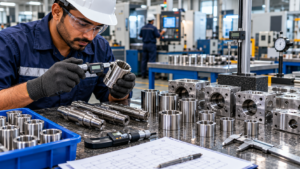
4. Verify the Availability of Suitable Measuring Instruments
Inspection equipment should match the component’s geometry and the accuracy required.
Common instruments used in precision manufacturing include micrometers, vernier calipers, bore gauges, height gauges, dial indicators, and surface roughness testers. More complex requirements may call for specialised metrology equipment.
For example, a micrometer may be suitable for checking an external shaft diameter, while a bore gauge may be needed to inspect an internal diameter.
The supplier should also understand the limitations of each instrument. A measurement tool that is unsuitable for a particular tolerance or feature cannot reliably demonstrate conformity.
When evaluating a supplier, consider whether:
- Appropriate measuring instruments are available.
- Instruments are maintained and calibrated as required.
- Inspection methods are suitable for the specified dimensions.
- Measurement results are recorded when necessary.
- Nonconforming components are identified and controlled.
Dimensional accuracy in manufacturing depends on more than machine capability. It also requires suitable measurement methods, trained personnel, and consistent inspection practices.
You can review the measurement and inspection capabilities described on the Vaani Precision Industries website for additional context about industrial quality-control equipment.
5. Understand Material Selection and Traceability
The choice of material can affect a component’s strength, machinability, wear characteristics, corrosion resistance, and suitability for its intended application.
A supplier should follow the material grade and specifications approved for the component. Substituting a material without the customer’s approval can introduce performance or compliance risks.
Material verification becomes particularly important when components are intended for demanding industrial applications.
Depending on the order requirements, relevant controls may include:
- Checking material identification and grade.
- Reviewing material test certificates.
- Maintaining batch or heat-number records.
- Preventing material mix-ups during storage and processing.
- Linking material documentation to the relevant production batch.
- Maintaining traceability records when specified.
Traceability helps manufacturers investigate defects, verify material history, and identify potentially affected batches if a problem is discovered later.
The level of documentation required will depend on the industry, customer specifications, and contractual obligations. It is therefore useful to establish these expectations before issuing the purchase order.
6. Evaluate Production Capacity and Delivery Planning
A supplier may have suitable machinery and strong technical skills but still struggle to meet your delivery schedule if its production capacity is already committed.
Before approving a supplier, discuss the planned quantity, expected order frequency, manufacturing lead time, and delivery requirements.
Ask how the supplier plans to manage:
- Raw-material availability
- Machine scheduling
- Tooling and setup time
- Inspection and approval stages
- External processing, if applicable
- Packaging and dispatch
- Unexpected machine downtime
For repeat orders, it is also important to understand whether the supplier can maintain consistent production over time.
A realistic production plan should account for more than the machine’s programmed cycle time. Setup, loading, tool changes, inspection, and material handling also affect the time required to complete an order.
A supplier that communicates realistic lead times and potential constraints is often easier to work with than one that promises aggressive delivery dates without explaining its production plan.
7. Request a Prototype or First-Article Sample
When introducing a new component, a prototype or first-article sample can help identify problems before committing to a larger production run.
The purpose is not merely to confirm that the part has been manufactured. It is to establish whether the component meets the agreed technical requirements.
A first-article review may cover:
- Critical dimensions
- Material verification
- Surface finish
- Fit with mating components, where applicable
- Required documentation
- Manufacturing feasibility
- Potential improvements to the production process
Any design or process change should be evaluated through the appropriate approval procedure.
For repeat production, an approved sample and documented manufacturing requirements can help establish a consistent reference for subsequent batches.
This approach can reduce the risk of discovering widespread dimensional problems only after a large quantity has been produced.
8. Compare Total Cost Instead of Purchase Price Alone
Price is an important consideration, but the lowest quotation does not always represent the lowest overall manufacturing cost.
A component that is inexpensive to purchase may become costly if it requires frequent rework, additional inspection, corrective machining, or replacement.
When comparing quotations, examine the complete commercial and technical offer.
Consider whether the price includes:
- Raw material
- Tooling and fixtures
- Machining operations
- Required finishing processes
- Inspection and documentation
- Packaging
- Transportation
- Prototype or first-article activities
Also consider the potential costs of rejected parts, production interruptions, delayed deliveries, and inconsistent quality.
A fair comparison evaluates suppliers against the same drawing revision, material specification, quantity, quality requirements, and delivery terms.
This creates a more reliable basis for selecting a supplier that can meet the business’s long-term manufacturing needs.
9. Review Communication and Problem-Solving Practices
Manufacturing projects often involve technical questions, drawing revisions, material constraints, and changes in production schedules. The supplier’s communication practices can significantly affect how efficiently these issues are resolved.
Before starting production, establish clear points of contact and agree on how technical clarifications, approvals, and changes will be documented.
A dependable supplier should be able to communicate:
- Whether a drawing is ready for production
- Which technical details require clarification
- Whether a requested delivery date is achievable
- How deviations and nonconformities will be handled
- When inspection results will be available
- How approved changes will be incorporated
When a problem occurs, the objective should be to identify the cause, contain affected parts, agree on corrective action, and prevent recurrence where possible.
This is particularly valuable for manufacturers managing repeat orders or supplying components used in larger assemblies.
10. Match the Supplier’s Experience to Your Industry
Different industries have different operating conditions and documentation requirements.
Railway components may need to satisfy application-specific requirements related to dimensional accuracy, durability, and assembly. Automotive manufacturers may focus on repeatability, production volumes, and process consistency. Defence and aerospace projects may involve additional material, inspection, documentation, or approval requirements depending on the component and programme.
A supplier’s experience should therefore be evaluated against the actual requirements of the intended application.
Ask for relevant examples of manufacturing capabilities, equipment, inspection processes, and quality documentation. Where customer confidentiality limits the information that can be shared, the supplier should still be able to explain its general process and demonstrate relevant technical competence.
Avoid assuming that experience in one industry automatically qualifies a supplier for another. The required capabilities and acceptance criteria should be assessed individually.

How Vaani Precision Industries Approaches Precision Manufacturing
Vaani Precision Industries specialises in precision machining and medium fabrication, producing customised components according to customer drawings and requirements. Its website describes capabilities serving industries that include railways, defence, aerospace, automotive, and other engineering applications.
The company’s published manufacturing capabilities include CNC turning, VMC machining, grinding, cutting, and fabrication-related processes. Its quality information also describes in-process monitoring, dimensional inspection, and material verification practices.
These capabilities illustrate several of the factors businesses can review when assessing a potential manufacturing partner: equipment suitability, drawing-based production, inspection arrangements, and the ability to address application-specific requirements.
To learn more, explore Vaani Precision Industries’ manufacturing capabilities and precision manufacturing services.
Prospective customers should confirm the specific equipment, capacity, tolerances, documentation, and delivery arrangements required for their own components before placing an order.
A Practical Checklist Before Approving a Supplier
Before moving into production, procurement and engineering teams can use the following checklist:
- Confirm that the supplier understands the latest approved drawing.
- Verify the availability of suitable machinery and tooling.
- Agree on the required material grade and documentation.
- Define critical dimensions and inspection criteria.
- Confirm suitable measuring instruments and calibration arrangements.
- Establish prototype or first-article approval requirements.
- Review production capacity and the delivery schedule.
- Clarify packaging, transport, and documentation responsibilities.
- Define how nonconforming parts and engineering changes will be handled.
- Compare quotations using consistent technical and commercial requirements.
Not every project requires the same level of documentation or inspection. The checklist should be adapted to the component’s complexity, risk, industry, and customer requirements.
Conclusion
Choosing a precision machining supplier requires a balanced assessment of technical capability, quality control, material traceability, production capacity, communication, and overall cost.
The most suitable supplier is not necessarily the one offering the lowest quotation or the largest list of machines. It is the one that can demonstrate an appropriate manufacturing process, understand the component’s requirements, verify conformity, and communicate clearly throughout the order.
By evaluating these factors before production begins, businesses can make more informed sourcing decisions, reduce avoidable manufacturing risks, and build stronger relationships with their component suppliers.
For manufacturers seeking customised precision-machined components, a structured supplier-evaluation process is an important step toward achieving consistent quality and dependable production.